What Are Inflatable Interactive Games? A Guide to Features and Benefits
Inflatable interactive games have become a popular entertainment option for festivals, birthday parties, school events, corporate gatherings, and recreational venues. Unlike traditional inflatables designed mainly for bouncing or sliding, interactive versions encourage participants to complete challenges, compete for points, test their skills, or work together toward a shared goal. Their colorful designs and engaging activities make them suitable for events where organizers want to create memorable experiences for visitors.
For event planners, rental businesses, and entertainment providers, Inflatable Interactive Games offer flexible ways to combine physical activity with friendly competition. These attractions can include sports challenges, target games, obstacle courses, and other interactive experiences that encourage active participation. Understanding their main features, benefits, and operating requirements can help buyers choose suitable equipment for their audience, venue, and budget.
What Are Inflatable Interactive Games?
Inflatable interactive games are inflatable attractions designed to involve participants in a specific activity rather than simply provide a space for free play. They typically feature defined objectives, such as hitting a target, scoring a goal, completing an obstacle challenge, or achieving the highest score within a set time.
Depending on the product, participants may play individually, compete against one another, or work in teams. Some attractions focus on physical movement, while others emphasize accuracy, coordination, reaction time, or strategic thinking.
These games are available in different sizes and designs, making them suitable for a variety of settings. Smaller attractions may fit into indoor activity areas or private parties, while larger installations may be better suited to outdoor festivals, sports events, and commercial entertainment venues.
Common Types of Inflatable Interactive Games
The best game type depends on the audience, available space, event purpose, and level of activity desired. Several formats are commonly used for interactive entertainment.
1. Inflatable Sports Games
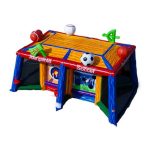
Sports-themed inflatables recreate familiar activities in an interactive format. Examples include soccer shooting challenges, basketball shooting games, football target competitions, and other sports-inspired attractions.
These games can appeal to children, teenagers, and adults, depending on the design and operating rules. Organizers can introduce scoring systems or team competitions to encourage participation and friendly rivalry.
Sports games are particularly useful for school fairs, corporate events, sports festivals, and community celebrations.
2. Inflatable Target Games
Target games challenge participants to aim at designated openings, marked areas, or scoring zones. Depending on the attraction, players may throw or kick a ball or use another specified piece of equipment.
The objective is usually straightforward, making these games easy to introduce at events with a wide range of visitors. They can also support short rounds, allowing organizers to manage queues efficiently.
3. Inflatable Obstacle Courses
Obstacle courses feature a sequence of challenges that participants navigate from start to finish. Depending on the model, these may include tunnels, barriers, climbing sections, and other physical elements.
Some obstacle courses are designed for individual attempts, while others may support suitable team-based competitions. Their combination of movement and challenge makes them appealing at camps, festivals, company activity days, and recreational facilities.
Because obstacle courses can require substantial installation space and active supervision, organizers should carefully review their specifications before purchasing or renting them.
4. Inflatable Team Challenge Games
Team-based inflatables encourage participants to cooperate or compete in groups. These attractions may involve shared scoring objectives, alternating turns, or completing a challenge together.
They can be useful for corporate team-building events, school activities, and community gatherings where social interaction is an important goal.
Clear rules and balanced team formats help keep the experience enjoyable for participants with different levels of experience.
5. Multi-Activity Inflatable Attractions
Some inflatables combine several interactive activities within one structure or coordinated setup. A single attraction might offer multiple sports challenges or different ways to earn points.
Multi-activity designs can provide variety without requiring separate installations for every game. However, buyers should confirm which activities are included, how participants move between them, and whether different sections can operate simultaneously.
Key Features of Inflatable Interactive Games
Although designs vary, several features influence how these attractions function and how useful they are for commercial or recreational purposes.
Interactive Objectives and Scoring
Many games have a clearly defined goal, such as scoring points, hitting targets, or completing a course. These objectives give participants a reason to engage with the activity and make it easier to organize competitions.
Some games use manual scorekeeping, while others may include electronic scoring or timing features. Buyers should confirm whether any electronic components are included and what additional power, maintenance, or setup they require.
Colorful and Attention-Grabbing Designs
Bright colors, sports themes, and large inflatable structures can help attract attention at busy venues. A distinctive design may make an activity zone easier for visitors to recognize.
Businesses can also investigate customization options, including colors, graphics, and branding, when these are offered by the manufacturer. Any customization should preserve required safety information and must not interfere with the equipment’s intended use.
Different Sizes and Configurations
Interactive inflatables are available in a range of dimensions and layouts. This variety allows organizers to compare products for small parties, indoor events, outdoor festivals, or permanent recreational facilities.
The overall installation footprint matters as much as the main structure’s dimensions. Space may also be needed for anchoring, blowers, entrances, exits, queues, spectators, and required safety clearances.
Reusable and Transportable Designs
Many inflatable attractions are designed to be deflated, packed, transported, and installed again. This can be useful for rental companies and event providers that serve multiple locations.
However, portability depends on the product’s size, weight, packing requirements, and included accessories. Buyers should ask about handling procedures, transportation needs, storage conditions, and recommended staffing for setup.
Options for Different Audiences
Some interactive games are designed for younger children, while others are intended for older participants or broader age groups. Choosing an appropriate model helps ensure that the challenge matches the audience.
Always review the manufacturer’s age recommendations, participant limits, and operating restrictions before making a purchase.
Benefits of Inflatable Interactive Games
Interactive inflatables offer several potential advantages for businesses, event organizers, and recreational facilities.
1. Encourage Active Participation
These games invite visitors to take part instead of simply watching. Participants can aim, throw, kick, navigate obstacles, or complete other activities depending on the attraction.
This active format can add variety to events and provide a recreational alternative to passive entertainment.
2. Create Memorable Event Experiences
Interactive challenges give visitors something specific to try and remember. Completing a difficult target challenge or contributing to a team’s score can create enjoyable shared moments.
For event organizers, these experiences can help make an activity area feel more engaging and give visitors a reason to spend time exploring different attractions.
3. Support Teamwork and Social Interaction
Games that involve shared objectives can encourage communication and cooperation. Participants may need to plan a strategy, take turns, or coordinate their efforts to reach a goal.
These activities can be especially valuable at school events, corporate gatherings, youth camps, and community celebrations where social interaction is part of the experience.
4. Provide Entertainment for Different Event Types
Interactive inflatables can be used at birthday parties, school fairs, sports days, corporate events, public festivals, and recreational centers.
The attraction should be selected according to the event’s audience, location, expected attendance, and operating resources. A suitable game can complement other activities and help create a more varied entertainment program.
5. Offer Commercial Opportunities
Rental companies and entertainment businesses may be able to add interactive inflatables to their service portfolios. Different game formats can help serve customers with different event themes and budgets.
Commercial success depends on local demand, purchase and operating costs, transportation, maintenance, pricing, and booking frequency. Businesses should evaluate these factors before investing in new equipment.
6. Allow Customization for Events and Brands
Some manufacturers offer custom designs or branding options. This can help businesses create attractions that match a corporate event, festival theme, school identity, or promotional campaign.
Before ordering, confirm the available customization choices, production timeline, minimum order requirements, and additional costs.
Where Can Inflatable Interactive Games Be Used?
These attractions can support many types of events and facilities when the selected equipment is appropriate for the venue.
Birthday Parties and Private Celebrations
Interactive games can add variety to birthday parties and family celebrations. Target challenges and smaller sports games may provide short, easy-to-understand activities for guests.
Organizers should select attractions suitable for the participants’ ages and the available installation space.
School Events and Summer Camps
Schools and camps can use interactive inflatables during sports days, seasonal celebrations, and recreational programs. Team challenges may encourage cooperation, while target games can provide opportunities to practice coordination and accuracy.
Activities should be age-appropriate, properly supervised, and integrated into a clear schedule.
Corporate Team-Building Events
Companies can incorporate interactive games into employee appreciation days, corporate retreats, and team-building programs. Friendly competitions offer opportunities for colleagues to interact outside their normal work responsibilities.
A variety of activities can help accommodate different preferences and encourage broader participation.
Festivals and Community Events
Public festivals often need attractions that are visually appealing and capable of engaging visitors throughout the event. Interactive inflatables can create a dedicated activity zone with several challenges.
Event planners should account for crowd flow, queue management, operating staff, and emergency access when arranging the area.
Resorts and Recreation Centers
Resorts and recreation centers may use interactive games as part of their scheduled entertainment or special events. Depending on the facility, suitable attractions can support family activities, seasonal programs, and group competitions.
For frequent use, buyers should give particular attention to construction quality, cleaning procedures, maintenance, storage, and ongoing operating costs.
How to Choose the Right Inflatable Interactive Games
Selecting an appropriate product involves balancing audience needs, practical requirements, and long-term value.
Consider Your Target Audience
Start by identifying the people who will use the attraction most frequently. A children’s event may require simple activities and specific age restrictions, while a corporate gathering may benefit from team challenges or sports competitions.
Consider the participants’ physical abilities, expected group size, and preferred activity styles before comparing products.
Measure the Available Space
Measure the intended installation area and check the complete space requirements. Include anchoring points, operating equipment, access areas, spectator zones, and the manufacturer’s specified clearances.
For indoor venues, confirm ceiling height, access routes, floor suitability, and electrical arrangements. For outdoor venues, check ground conditions and approved anchoring methods.
Evaluate Material and Construction Quality
Ask suppliers about the materials, seams, reinforcement, manufacturing quality controls, and suitability for repeated use.
If the attraction will be used commercially, clarify the conditions under which it is designed to operate and what maintenance is required. Product photographs alone are not enough to establish durability or safety.
Review Setup and Operating Requirements
Find out how the inflatable is installed, how many people are needed for setup, which accessories are included, and what power supply is required.
Also ask about participant limits, supervision requirements, weather restrictions, and the recommended inspection process.
Compare Total Costs
The full cost may include the product price, customization, shipping, installation, blowers, storage, maintenance, repairs, and staffing.
Businesses should estimate how frequently the attraction is likely to be used and compare expected revenue or recreational value with these expenses. Avoid assuming that high attendance automatically guarantees a profitable investment.
Check Supplier Support and Warranty
Choose a supplier that can provide clear product specifications, installation guidance, maintenance instructions, and information about applicable safety requirements.
Review warranty coverage, exclusions, replacement-part availability, and the process for requesting technical support. Written terms help clarify responsibilities before the order is placed.
Safety and Maintenance Considerations
Proper operation is essential for inflatable interactive games, especially at crowded events or venues with frequent use.
Follow Manufacturer Instructions
Install and operate the equipment according to the manufacturer’s guidance. Use approved anchoring arrangements, suitable blowers, and the required electrical setup.
Never exceed stated participant limits or use the attraction for activities that are not permitted by its instructions.
Provide Appropriate Supervision
Assign trained staff to manage access, explain rules, monitor participants, and respond to unsafe behavior. Children should receive supervision appropriate to their age and the attraction’s requirements.
Keep entrances, exits, and emergency routes clear throughout the event.
Monitor Weather and Site Conditions
Outdoor inflatables should only operate under conditions allowed by the manufacturer. Establish a process for monitoring wind, rain, lightning, and other factors that may require an activity to stop.
The installation area should be suitable for the attraction and free from hazards that could affect safe operation.
Inspect and Clean Equipment Regularly
Inspect the inflatable and its operating equipment before use and at suitable intervals during operation. Follow the manufacturer’s cleaning, drying, repair, and storage procedures.
If damage or instability is identified, stop using the attraction until the issue has been properly assessed and resolved.
Conclusion
Inflatable interactive games combine physical activity, skill-based challenges, and friendly competition in an engaging entertainment format. From sports games and target challenges to obstacle courses and team activities, these attractions can suit a wide range of events and recreational settings.
Their main benefits include encouraging active participation, supporting social interaction, creating memorable experiences, and offering flexible entertainment options. However, choosing the right product requires careful consideration of the audience, installation space, construction quality, safety requirements, supplier support, and total operating costs.
By evaluating these factors before purchasing and following appropriate operating and maintenance procedures, event organizers and commercial buyers can select inflatable interactive games that meet their needs and provide enjoyable experiences for participants.