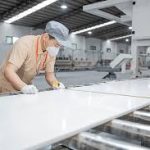
Automation is becoming an important part of modern manufacturing as industries look for ways to improve production speed, maintain consistent quality, and control operating costs. The solid surface industry is no exception. Producing sheets, countertops, vanity tops, integrated basins, and customized architectural components requires careful control over raw materials, processing conditions, dimensions, and finishing quality.
Traditional manufacturing methods often depend heavily on manual measurements and operator experience. Although skilled workers remain essential, automated equipment can make many production activities more accurate and repeatable. A modern Solid Surface Manufacturer can use automation to improve material handling, formulation control, production monitoring, inspection, and packaging while supporting the changing requirements of residential and commercial projects.
1. Improving Raw Material Measurement and Mixing
Solid surface production commonly involves combining resin, mineral fillers, pigments, and other additives according to specific formulations. Accurate measurements are important because variations in ingredient proportions can influence the final material’s appearance and properties.
Manual measurement can introduce inconsistencies, particularly when manufacturers handle large production volumes or multiple formulations.
Automated weighing and dosing systems help control ingredient quantities more precisely. These systems can be programmed to follow established production recipes and reduce the risk of measurement errors.
Automated mixing equipment can also maintain consistent mixing speeds and processing times. This supports more repeatable material preparation and helps production teams manage different product specifications.
2. Increasing Production Speed
Manufacturing efficiency depends partly on how quickly materials move through each production stage. Delays in preparation, molding, curing, cutting, or finishing can affect the overall production schedule.
Automation helps reduce unnecessary manual operations and improve coordination between different stages.
For example, automated material transfer systems can move ingredients or semi-finished products between designated work areas. Programmable equipment can also perform repetitive operations according to predefined settings.
The result may include shorter processing times, improved production flow, and better use of available equipment.
However, actual productivity improvements depend on the manufacturing process, equipment configuration, production volume, and operator training.
3. Maintaining Consistent Production Conditions
Solid surface materials require controlled processing conditions. Mixing time, temperature, curing duration, and other parameters may affect the quality of finished products.
When these conditions are managed manually, variations can occur between production runs.
Automated control systems allow manufacturers to monitor and adjust selected parameters according to established process requirements.
Depending on the equipment, automation may support:
- Temperature monitoring
- Processing time control
- Mixing speed adjustment
- Equipment operating sequences
- Production data recording
- Process alarms and notifications
Maintaining more consistent conditions can reduce avoidable variations and help manufacturers produce materials that meet established specifications.
4. Reducing Human Errors in Repetitive Tasks
Manufacturing involves many repetitive activities, including measuring ingredients, operating machinery, cutting materials, and checking dimensions.
When workers perform these tasks repeatedly, fatigue or incorrect settings may contribute to errors.
Automation can handle certain repetitive operations according to programmed instructions. This reduces dependence on manual execution for tasks that require consistent measurements or repeated movements.
For example, automated cutting equipment can follow digital measurements, while programmable systems can repeat established production sequences.
Human supervision remains important because operators must verify machine settings, inspect results, and respond to unexpected conditions.
5. Improving Cutting Accuracy and Material Utilization
Cutting solid surface sheets into specific dimensions is an important manufacturing and fabrication activity. Incorrect measurements can create material waste and increase the time required for additional processing.
Computer-controlled cutting equipment can follow digital designs and repeat cutting patterns with greater consistency.
Automated or software-assisted nesting systems can also arrange multiple components on a sheet to improve material utilization.
Potential benefits include:
- More accurate component dimensions
- Reduced unnecessary offcuts
- Faster cutting operations
- Repeatable production results
- Improved order planning
Efficient cutting is particularly useful for customized projects that require multiple components with different shapes and sizes.
6. Supporting Customized Product Manufacturing
Customization is an important requirement in the solid surface industry. Architects and designers may request special colors, curved surfaces, integrated basins, unusual dimensions, or distinctive edge profiles.
Automation can help manufacturers handle these requirements more efficiently.
Digital design systems can translate drawings into production instructions for compatible machinery. Computer-controlled equipment can then perform selected cutting, shaping, and machining operations.
This can improve accuracy when producing complex or repeated components.
However, custom products still require technical evaluation. Material suitability, tooling requirements, forming limitations, and finishing methods must be reviewed before manufacturing begins.
7. Improving Curing Process Management
Curing is a critical stage in solid surface production because it influences how the material develops its final characteristics.
The appropriate curing conditions depend on the resin system, formulation, and manufacturing method. Variations in temperature or processing time may contribute to inconsistent results.
Automated monitoring systems can help manufacturers control curing conditions more reliably.
These systems may record operating temperatures, monitor processing durations, and alert operators when conditions move outside established limits.
Accurate process records also help production teams investigate defects and identify possible causes of variation.
8. Enhancing Surface Finishing Operations
Surface finishing affects the final appearance and usability of solid surface products. Sanding, polishing, trimming, and edge finishing require suitable equipment and consistent techniques.
Some finishing operations can be automated or supported by programmable machinery.
Automated sanding and polishing equipment may follow repeatable movement patterns and maintain more consistent processing conditions. This can help reduce differences between finished components.
Automation is particularly useful for products manufactured in larger quantities or with repeated specifications.
Nevertheless, final inspection remains necessary because surface appearance can be affected by material characteristics, tooling conditions, and finishing requirements.
9. Using Automated Inspection and Measurement Systems
Quality control is essential in solid surface manufacturing. Products may need to meet specific requirements for thickness, dimensions, surface appearance, and other technical properties.
Manual inspection is valuable, but it can be time-consuming when manufacturers handle large production volumes.
Automated measurement systems can support more efficient inspection by checking selected dimensions and identifying certain surface irregularities.
Depending on the equipment, manufacturers may use:
- Digital thickness measurement
- Laser-based dimensional inspection
- Machine vision systems
- Automated weighing
- Process monitoring sensors
- Digital quality records
These technologies can help identify deviations earlier and reduce the possibility of unsuitable products reaching customers.
10. Reducing Material Waste and Production Costs
Material waste can increase manufacturing expenses and reduce production efficiency. Waste may result from inaccurate measurements, defective products, unnecessary trimming, or poorly planned production schedules.
Automation can help address these issues by improving process accuracy and material tracking.
For example, automated dosing systems reduce the risk of incorrect ingredient quantities, while digital cutting plans can improve sheet utilization.
Production monitoring systems may also help identify recurring defects and inefficient operating conditions.
Reducing waste provides both financial and operational benefits. Manufacturers can use resources more effectively while limiting unnecessary disposal and reprocessing.
11. Improving Inventory and Material Management
Efficient production depends on having the correct raw materials available when required. Poor inventory management can create production delays, excessive storage costs, or material shortages.
Digital inventory systems can help manufacturers track raw material quantities, product batches, and warehouse movements.
When integrated with production planning software, these systems may provide information about:
- Current raw material availability
- Material consumption rates
- Reorder requirements
- Production batch information
- Finished product quantities
- Warehouse locations
This information supports more accurate purchasing and helps production managers coordinate material availability with manufacturing schedules.
12. Supporting Better Production Planning
Manufacturers often manage multiple orders with different specifications, quantities, and delivery deadlines. Without effective planning, production lines may experience scheduling conflicts or unnecessary downtime.
Production management software can help organize orders and allocate available resources.
These systems may assist with:
- Reviewing incoming customer orders.
- Checking raw material availability.
- Assigning production schedules.
- Monitoring equipment utilization.
- Tracking manufacturing progress.
- Identifying possible delivery delays.
Better scheduling can improve coordination between departments and make production capacity easier to manage.
13. Increasing Workplace Safety
Automation can also improve workplace safety by reducing the need for employees to perform certain repetitive or physically demanding operations.
Material handling equipment, automated lifting systems, and machine-assisted cutting can reduce some manual handling requirements.
However, automated machinery introduces its own safety risks. Moving equipment, cutting tools, electrical systems, and chemical processing areas require appropriate safeguards.
Manufacturers should provide machine guards, emergency stops, operating procedures, employee training, and regular equipment inspections.
Automation should support a safer working environment rather than replace proper safety management.
14. Improving Product Traceability
Traceability allows manufacturers to identify the materials, processes, and production records associated with a particular product batch.
This information is useful when investigating quality issues, responding to customer complaints, or managing repeat orders.
Digital production systems can record information such as:
- Raw material batch numbers
- Formulation details
- Production dates
- Machine operating conditions
- Inspection results
- Packaging information
A traceability system helps manufacturers identify where variations may have occurred and supports more effective corrective action.
It can also make communication with distributors and project buyers more transparent.
15. Supporting Consistent Large-Volume Production
Large construction projects, hospitality developments, and commercial installations may require substantial quantities of solid surface materials.
Manufacturers must maintain consistent specifications while managing higher production volumes and tight delivery schedules.
Automation can help repeat established processes and reduce variations between production runs.
For example, automated mixing and dosing equipment can follow consistent formulations, while digital cutting systems can reproduce approved dimensions.
Batch monitoring and inspection records further support quality consistency.
However, production capacity still depends on equipment availability, maintenance, staffing, and effective management.
16. Combining Automation with Skilled Employees
Automation does not eliminate the need for experienced manufacturing personnel. Employees remain essential for supervising production, solving technical problems, evaluating unusual defects, and managing customized requirements.
A balanced manufacturing system combines automated processes with human expertise.
Workers may be responsible for:
- Setting and verifying machine parameters
- Reviewing production data
- Inspecting finished products
- Maintaining equipment
- Handling unusual production conditions
- Improving manufacturing procedures
Training is particularly important when new machinery or software is introduced. Employees should understand both normal operating procedures and the correct response to system warnings or equipment failures.
17. Managing the Investment in Automation
Although automation can improve efficiency, installing new equipment requires careful financial planning.
Initial expenses may include machinery, software, installation, employee training, and changes to existing production layouts.
Manufacturers should evaluate whether the expected operational benefits justify the investment.
Important considerations include:
Production volume: Will the equipment be used frequently enough to justify its cost?
Labor requirements: Can automation reduce repetitive work or improve workforce productivity?
Material savings: Will more accurate processes reduce waste and rework?
Maintenance expenses: What are the expected servicing and replacement costs?
Training needs: How much employee instruction is required?
Integration: Can the new system work with existing production equipment?
A phased approach can be useful. Manufacturers may begin by automating high-volume or error-prone tasks before expanding to other production areas.
18. Using Data to Support Continuous Improvement
Modern automation systems can generate valuable production information. Manufacturers can use this data to understand equipment performance, identify recurring defects, and improve manufacturing procedures.
For example, production records may reveal that certain defects occur more frequently during specific processing conditions.
Managers can review this information and investigate whether changes to equipment settings, raw materials, or operator procedures are needed.
Useful performance indicators include:
- Production output per shift
- Equipment downtime
- Material waste percentage
- Defect and rejection rates
- Production cycle time
- On-time order completion
- Energy consumption per production unit
Regular analysis helps manufacturers measure whether automation is delivering practical improvements.
19. Preparing for Future Developments in Smart Manufacturing
Automation technology continues to develop, creating additional opportunities for the solid surface industry.
Some manufacturers may explore connected machinery, advanced sensors, machine vision, predictive maintenance, and artificial intelligence-supported production analysis.
These technologies can potentially improve equipment monitoring and help identify process problems before they cause significant interruptions.
Digital design integration may also make customized production more efficient by connecting product specifications with manufacturing equipment.
The most useful technologies will depend on the manufacturer’s production requirements, technical resources, and investment priorities.
Conclusion
Automation helps solid surface manufacturers improve product efficiency by supporting accurate material measurement, consistent processing conditions, precise cutting, effective quality inspection, and better production planning. It can also reduce repetitive manual tasks, limit material waste, improve traceability, and support customized manufacturing requirements.
However, successful automation requires more than purchasing advanced machinery. Manufacturers must select suitable equipment, train employees, maintain production systems, and use accurate data to guide improvements. Combining automated processes with skilled personnel allows manufacturers to strengthen operational efficiency while maintaining the quality and flexibility required by modern interior design and construction projects.